
Pulaski County Court Records After a Jail Arrest
Once a person is arrested and booked in Pulaski County, the Pulaski County State's Attorney reviews the case and decides what formal charges to file. That filing opens a court case, and the case becomes the court record that follows the arrest. The prosecutor, currently Lisa Casper, can file the charges the arresting officers listed, change them, reduce them, add counts, or decline to charge at all. So the charge on a booking sheet is not always the charge that ends up in court.
It helps to keep two record types apart. The arrest and booking side, including custody and any booking photo, lives with the jail and is covered on the jail inmate records and jail roster mugshots pages. The court record, meaning the charges the prosecutor actually filed and how the case moves, lives with the Circuit Clerk and the public court portal. This page is about that second record, the court record after an arrest.
How to Find Pulaski County Court Records After an Arrest
Pulaski County court records run through the First Judicial Circuit, the Circuit Clerk, and Judici, the online court portal the sheriff's office points users to. Judici lists Pulaski County as a participating court, and its data includes litigant information, criminal charges, dispositions and sentences, fines and fees, hearing dates, case minutes, and documents. The Pulaski County case-search page may show a browser verification step before it loads, so a normal browser session helps.
- Open the Judici case search for Pulaski County and complete any "verify your humanity" step.
- Search by the defendant's name or by case number if you have it.
- Open the case and read the charge list, then check each charge's status.
- If the case is new, check again later or call the Circuit Clerk, since court filings can lag the arrest.
For statewide criminal-history records, the Illinois State Police Bureau of Identification handles official rap-sheet requests, which is a separate process from a single county case lookup. For court-date or payment questions, call the Circuit Clerk at 618-748-9300 during posted hours.
The Judici court list confirms Pulaski County as a participating court, which is the starting point for an online case search.
The public Judici participating-courts list shows Pulaski County, Illinois among the courts available for case search.
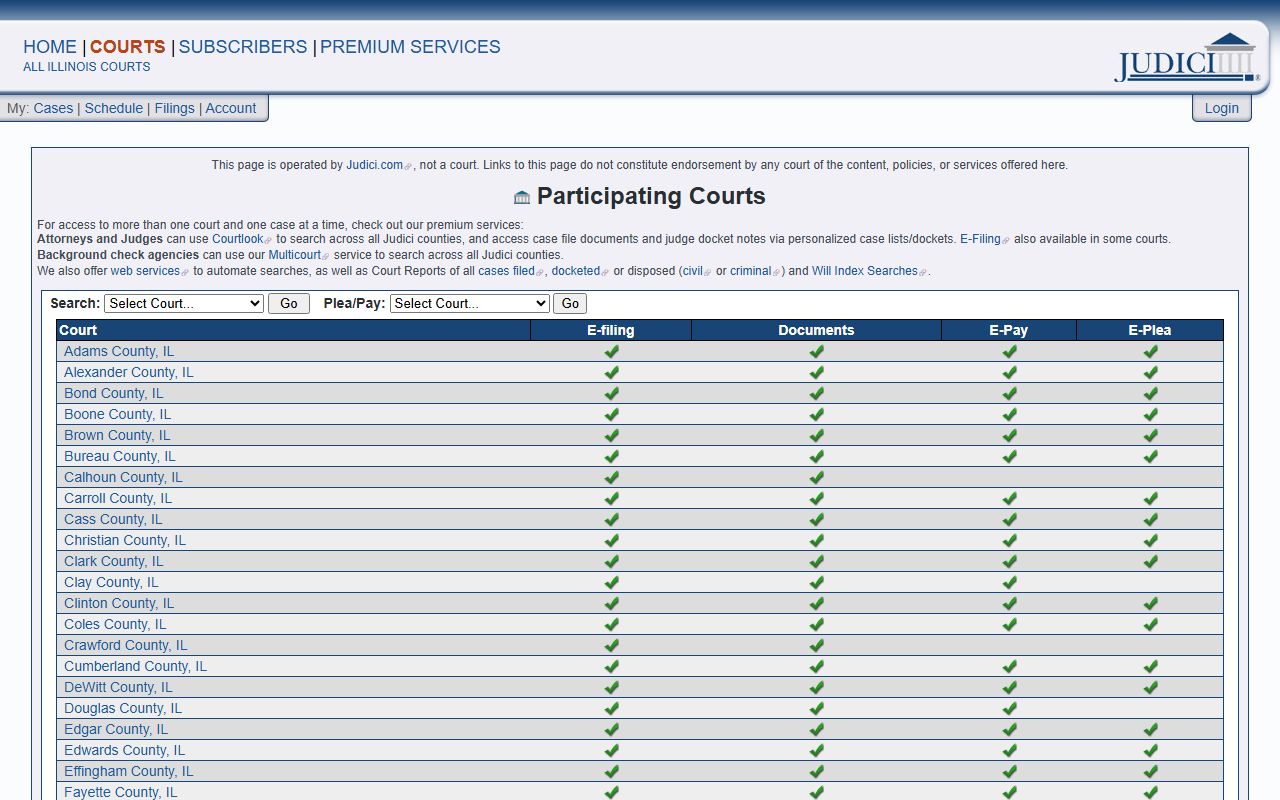
From that list, the Pulaski County case search opens the filed charges and hearing record for a defendant.
Judici Court Search Fields for Pulaski County
The Judici case search is the public route for Pulaski County court records after an arrest. Basic public access is free, while premium attorney and background services are separate. During inspection the Pulaski case-search page reached a verification screen, so exact field labels could not all be confirmed, but the portal and homepage describe the controls below.
| Field Label | Type | Required | Notes |
|---|---|---|---|
| Court | Select | Yes | Pulaski County, Illinois is listed as a participating court. |
| Name | Text | One search path | Search by defendant or litigant name. |
| Case Number | Text | One search path | Use if the case number is known. |
| Verification | Step | As prompted | A "verify your humanity" page may appear before results. |
How Pulaski County Charges Get Filed After an Arrest
The court record after an arrest begins with a charging document. After booking at the jail, the prosecutor decides how to charge, and the type of document depends on the offense and the path the case takes. Each one starts the formal case and frames what the court record will show.
| Complaint | Information | Indictment | |
|---|---|---|---|
| Filed By | Officer / Prosecutor | Prosecutor | Grand Jury |
| Common For | Misdemeanors and case starts | Many felonies | Serious felonies |
| Starts | The case | The case | The case |
Because charges can shift between the arrest and the filing, the charging document and the docket are better sources than the original booking line. A single arrest can lead to no filed case, one case, amended charges, several counts, or a transfer to another court such as a federal or out-of-county case.
Charge Status in Pulaski County Court Records
Charges change as a case moves through court. The booking charges on the jail side can differ from what the prosecutor finally files, and the filed charges can still be amended or dropped. The court record uses status terms to show where each charge stands, and a few come up often.
| Status | What It Means |
|---|---|
| Pending | The charge or case is still open and not yet resolved. |
| Amended / Reduced | The prosecutor changed the charge, often to a lower offense. |
| Dismissed | The court or prosecutor ended the charge without a conviction. |
| Nolle Prosequi | The prosecutor formally declined to proceed on the charge. |
A disposition is the final or current outcome of a charge, and a conviction, by plea or verdict, is different from an arrest. The court record can still show a charge after a person is released from jail, which is why the court file outlasts the custody record.
Bond and Release After a Pulaski County Arrest
Illinois no longer uses the old cash-bail system for new pretrial decisions. Since September 18, 2023, a judge decides pretrial release or detention through individualized findings, and a risk tool cannot be the only basis to deny release. The court, not a posted bond amount, controls whether a person leaves custody after an arrest. The terms below replace the old cash-and-surety language for new cases.
- Pretrial release
- The court allows release before the case ends, usually with conditions.
- Pretrial detention
- The court orders the person held after the State files a detention petition and the law's tests are met.
- Prior bail security
- Older deposits posted before the reforms are handled under 725 ILCS 5/110-7.5.
- Hold or detainer
- Another agency's hold can keep a person in custody even when the local case would allow release.
Pretrial decisions are governed by 725 ILCS 5/110-6.1, which sets when a court may deny pretrial release. To check release status, call the jail at 618-845-3512, check the case on Judici, and confirm whether a U.S. Marshals or other hold applies.
Pulaski County Court Offices After an Arrest
Several offices handle different parts of a court record after a Pulaski County arrest, and calling the right one saves time. They sit together at the courthouse at 500 Illinois Avenue in Mound City, which is separate from the jail in Ullin.
- Circuit Clerk - Stephanie Crain, 618-748-9300, for the public case index, copies, payments, and docket questions.
- State's Attorney - Lisa Casper, 618-748-9134, the prosecutor who files and handles the charges.
- Presiding Circuit Judge - William J. Thurston, 618-748-9100, the judicial office; not a source of legal advice.
- Probation - 618-748-9643, for post-disposition supervision and court-services records.
The Circuit Clerk's office hours are Monday through Friday, 8:00 AM to noon and 1:00 to 4:00 PM. The clerk warns that if a citation is marked "court appearance required," the person must appear or contact the State's Attorney, since the clerk cannot reschedule court dates.
Warrants Behind a Pulaski County Arrest
Pulaski County does not publish a searchable active-warrant list on its official site. A warrant can still turn into a booking: an arrest warrant authorizes arrest on a charge, and a bench warrant often follows a failure to appear or a violated court order. When a person is arrested on a warrant or delivered to the jail on another agency's warrant, the detention center opens a custody record.
To check on a warrant, search the court case on Judici for failure-to-appear entries and warrant-related docket events, contact the Circuit Clerk for case-record questions, and call the jail only for current custody or hold status. For a warrant you believe is active, speak with an attorney or the court before appearing. Do not try to clear a warrant by walking into the jail without counsel.
Charges vs. Convictions
Being arrested and charged is not the same as being convicted. An arrest reflects probable cause, while a conviction requires proof beyond a reasonable doubt through a plea or a verdict. Both can appear in public records, but they mean very different things.
| Charge | Conviction | |
|---|---|---|
| Stage | Accusation | Verdict or plea |
| Burden of Proof | Probable cause | Beyond reasonable doubt |
| Public Record | Yes | Yes |
Sealed vs. Expunged Arrest Records
After a dismissal or an eligible outcome, a person may be able to clear an arrest or charge record. In Illinois, sealing and expungement are different remedies, and both usually require the court's order and the right paperwork. The Illinois State Police Bureau of Identification handles many record-clearing steps, including cannabis-related expungement changes.
| Sealed | Expunged | |
|---|---|---|
| Visibility | Hidden from most public access | Destroyed or treated as if it never existed |
| Law Enforcement | Limited access remains | Very limited access |
| Eligibility | Depends on the offense and outcome | Often after dismissal or an eligible disposition |
Background Check Considerations
A casual court-records lookup is not the same as a regulated background check. Formal screening for jobs, housing, credit, or insurance is governed by the federal Fair Credit Reporting Act and must run through a compliant consumer reporting agency. Public court records can be read by anyone, but using them to make those decisions carries legal duties this kind of site does not meet.
Important: This site is not a consumer reporting agency under the FCRA, and its information may not be used for employment, housing, credit, or insurance screening.
Restricted Court Records After an Arrest in Pulaski County
Not every court record after an arrest is open. Juvenile cases are confidential, sealed charges are hidden from most public access, and some dismissed or pending matters may be withheld or redacted. Illinois FOIA lets a public body withhold or redact exempt material, and records tied to an active investigation or to safety and security concerns can be held back. When a record is missing from the public portal, that does not always mean nothing happened. It may mean the record is restricted, sealed, or simply not yet filed.
The First Judicial Circuit directory is a reliable source for the court offices that hold these records, from the judge to the clerk to the State's Attorney.
The First Judicial Circuit Pulaski County directory lists the courthouse offices, phone numbers, and addresses in Mound City.
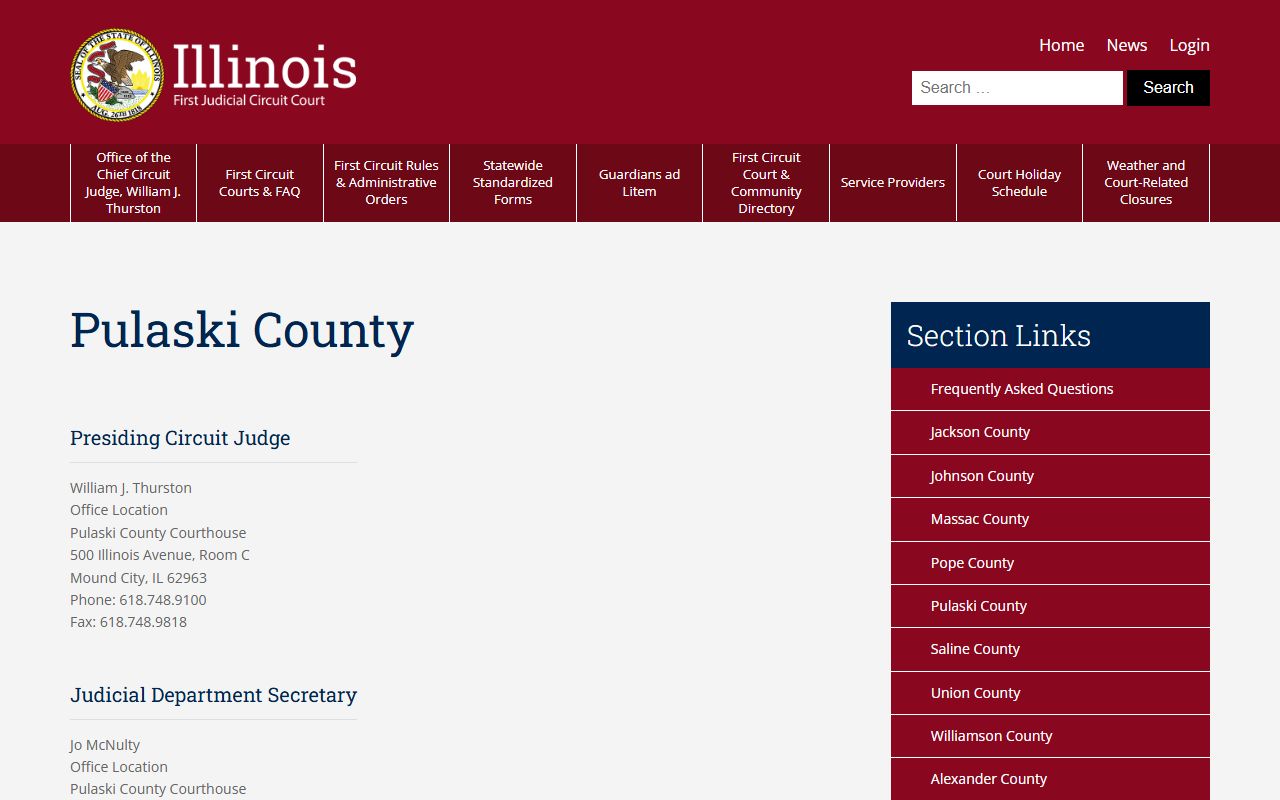
That directory is the place to confirm where to call or write for a court record the online portal does not show.